
Do not copy the fresh setting blindly for frozen food. Separate frozen pieces, remove loose surface ice, avoid crowding, and expect the early part of the cook to focus on thawing and drying. Use the package instructions when provided, especially for prepared frozen products.
On this page
At first, much of the heat entering frozen food is used to warm it and melt ice. The surface can also become wet as frost melts. Browning accelerates only after that moisture begins to leave. Fresh food skips the ice-melting stage, but it may contain more natural surface moisture or have a different structure.
What freezing changes
Heat must melt ice first
Frozen water absorbs substantial energy as it changes from solid to liquid. During that stage, the inside warms more slowly than a fresh equivalent. This is one reason a frozen thick piece can need a longer path to safe doneness.
Surface frost becomes moisture
Visible frost melts before it evaporates. If pieces are crowded, that moisture lingers and softens the surface. Brushing off loose ice and leaving air gaps can improve browning without changing the food itself.
Freezing changes structure
Ice crystals can damage cell walls in fruit and vegetables. When heated, they may release water faster and soften sooner than fresh produce. A frozen vegetable may therefore take longer to heat through but still lose firmness more quickly once hot.
Raw frozen food is not the same as a frozen convenience product
Many frozen fries, nuggets, pastries and snacks are partially cooked, blanched or coated before freezing. Some already contain oil designed to help them brown. They may cook directly from frozen very effectively and can become worse if thawed first.
By contrast, a raw frozen piece of meat or a solid block of food has a longer, more safety-sensitive path to the centre. Follow product and appliance instructions, separate pieces when possible, and verify safe internal doneness with an appropriate thermometer.
Should you thaw first?
Usually cook directly from frozen when the package explicitly says so, the pieces are small and separate, or the coating is meant to stay frozen until cooking.
Consider safe thawing first when pieces are frozen into a solid block, seasoning cannot reach the surface, or the outside is likely to over-brown before a thick centre cooks safely. Thaw per safe food-handling guidance—not on the kitchen counter.
A practical fresh-to-frozen adjustment
- Identify whether the item is raw, blanched, pre-cooked or coated.
- Remove loose frost and separate individual pieces.
- Leave enough basket space for moisture to escape.
- Use the same temperature only as an initial hypothesis, not a rule.
- Shake or turn after the surface has begun to thaw and release.
- Check texture and, where applicable, internal doneness before serving.
A much higher temperature can brown or dry the outside while the centre is still catching up. Often the better adjustment is more time, better spacing, and a well-timed shake or turn.
Fresh or frozen is a first-class input.
For supported preparations, Frygo lets you state whether the food is fresh or frozen instead of hiding that difference in a footnote. The selected state is combined with amount, preparation, crispiness and appliance profile before the recommendation and reminders are produced.
Your appliance, quantity and preferred crispiness all affect the result. Frygo combines these inputs and guides you through the cook.
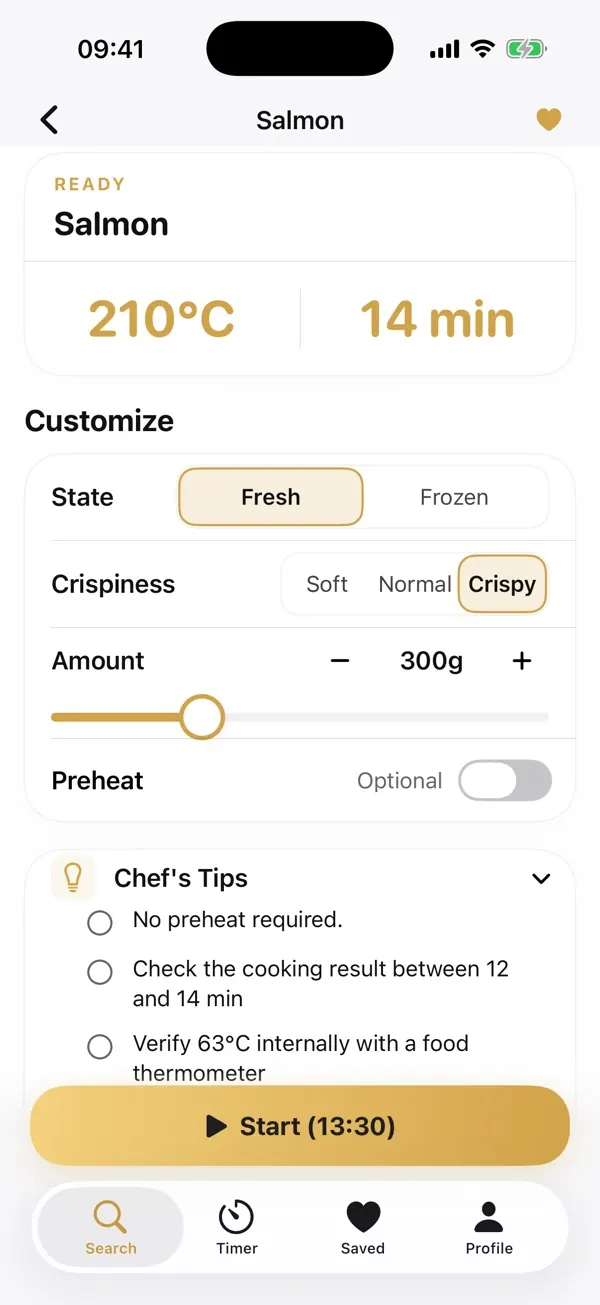
These ranges are general guidance, not tested results for every portion and appliance. Use the package and manufacturer instructions for your product and check doneness. Frygo adjusts in-app recommendations to your selections and feedback.
How Frygo creates recommendations →