
Keep food in a loose, even layer when crispness matters. For a larger load, expect to shake or turn more carefully and begin checking later than for a small portion. If the basket is crowded, two batches often produce a faster and crisper overall result than one overloaded batch.
On this page
An air fryer works by moving hot air across exposed surfaces. Adding food changes the amount of material that must be heated, but it can also cover basket openings, block the flow between pieces and release more moisture. Those effects are why quantity adjustments are not a simple multiplication problem.
What changes when you add more food
More thermal mass
A larger quantity starts with more total mass for the heater to warm. Cold or frozen food also cools the chamber when it goes in. The appliance then needs time to recover while still heating the centre of every piece.
Less exposed surface
Air transfers heat efficiently where it can touch the food. Pieces that overlap shield each other. The covered surfaces cook more slowly and steam more readily, while exposed edges may brown first. This is the main reason a heaped basket behaves differently from a single layer.
More moisture in the chamber
Food releases water as it heats. A larger load releases more moisture into the same chamber, and crowded pieces give that vapour fewer routes to escape. The result can be softer surfaces and slower browning even when the inside is heating normally.
Why the adjustment is not linear
If you double a single layer by moving from a small basket to a wider basket, the time may change only modestly because the airflow around each piece remains similar. If you double it by piling another layer into the same basket, the change can be much larger. Arrangement is therefore as important as weight.
Food shape matters too. Doubling the number of thin fries is different from doubling the thickness of a chicken breast. The fries mainly increase crowding; a thicker piece increases the distance heat must travel to the centre.
A practical quantity-adjustment method
- Start with basket coverage. Can air reach most surfaces, or are pieces tightly stacked?
- Keep temperature stable initially. More food does not automatically need a higher temperature. Raising heat can over-brown the outside before the centre catches up.
- Add movement. Shake small pieces or turn larger pieces so previously covered surfaces meet hot air.
- Use a check window. Inspect before committing to a large time extension, then continue in short increments.
- Batch when quality drops. For crisp foods, two loose layers cooked separately often beat one dense load.
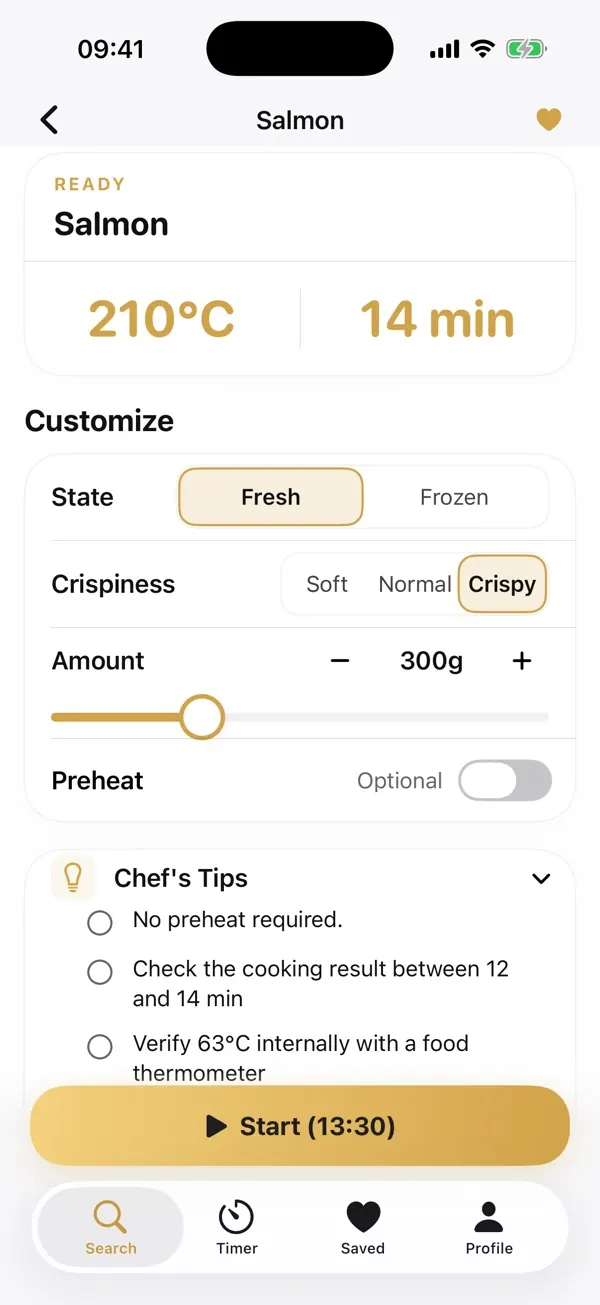
Equal weights can cook differently: 500 g of small loose pieces exposes far more surface than 500 g packed into a solid or overlapping layer. Weight tells Frygo how much energy is needed; preparation and appliance shape help describe how that heat reaches the food.
Examples
Frozen fries: a thin layer allows air around more edges. A deeper pile normally needs more shaking and time, and it may never become as uniformly crisp.
Broccoli florets: a larger quantity releases more steam. Leaving gaps and redistributing florets helps prevent tender centres with damp surfaces.
Chicken pieces: total weight matters, but so does individual thickness. Several separated small pieces can finish before one thick piece of the same combined weight.
Quantity is part of the recommendation.
Frygo asks for the amount instead of assuming every cook uses the same portion. It combines that with the selected food style, fresh or frozen state, crispiness and your appliance profile. Guided timers can then remind you to shake, flip or check at the useful stage.
Your appliance, quantity and preferred crispiness all affect the result. Frygo combines these inputs and guides you through the cook.
These ranges are general guidance, not tested results for every portion and appliance. Use the package and manufacturer instructions for your product and check doneness. Frygo adjusts in-app recommendations to your selections and feedback.
How Frygo creates recommendations →