
Treat any published time as a starting point. On the first cook with a new appliance or food, check earlier than the suggested finish, note the result, and adjust future cooks in small steps.
On this page
The practical answer is that an air fryer is a small convection oven, and every model creates its own cooking environment. Heater power matters, but so do the distance from heater to food, the path of the air, the usable basket area, the control system and how much food interrupts that airflow.
The five appliance differences that matter most
1. Airflow pattern
A powerful fan is useful only if the hot air reaches the food evenly. Basket holes, internal baffles, tray position and chamber shape determine where the air moves quickly and where slower pockets form. This is why one model may brown the top quickly while another produces a more even result with less turning.
2. Heater distance and cycling
The food in a shallow basket may sit closer to the heating element than food in a deep or stacked design. Meanwhile, the controller repeatedly switches or modulates the heater to hold a target temperature. Different cycling behavior can create different average heat levels even when both displays say the same thing.
3. Basket area and chamber volume
A wide basket spreads food into a thinner layer. A narrow basket encourages overlap. A large chamber also contains more air and may recover differently after you open it. Capacity printed in litres does not tell the whole story: usable surface area often matters more for crisping.
4. Temperature calibration
The displayed temperature is not a laboratory measurement at every point around the food. Sensors sit in one location, and the actual temperature naturally rises and falls as the heater cycles. Small calibration differences can become visible in short, hot cooks.
5. Preheating and heat recovery
Starting with a hot chamber changes the first minutes of cooking. So does opening the basket to shake or add another food. A compact model may recover quickly; a larger chamber or heavy load may need longer. That difference affects both browning and total duration.
Why wattage alone cannot predict the time
Wattage tells you the maximum electrical power drawn by the appliance, not how efficiently that energy reaches a particular piece of food. A lower-powered, compact fryer can sometimes cook a small portion faster than a higher-powered, larger model because the food sits closer to the heater and the chamber contains less air.
Use wattage as context, not as a conversion formula. There is no reliable rule such as “10% more watts means 10% less time.” Geometry, airflow and control behavior prevent that kind of simple scaling.
A dependable way to learn a new appliance
- Keep the first test simple. Use a familiar food, one even layer and a measured quantity.
- Use the recipe or chart as a baseline. Keep its temperature, but plan the first check before the stated end.
- Check the right signal. Look at browning and texture; for foods where safety matters, verify doneness with an appropriate thermometer.
- Change one variable next time. Adjust duration, quantity or crispiness—not all three together.
- Record the result. A short note such as “needed two minutes less in this basket” is more valuable than searching for another generic chart.
Your appliance becomes an input.
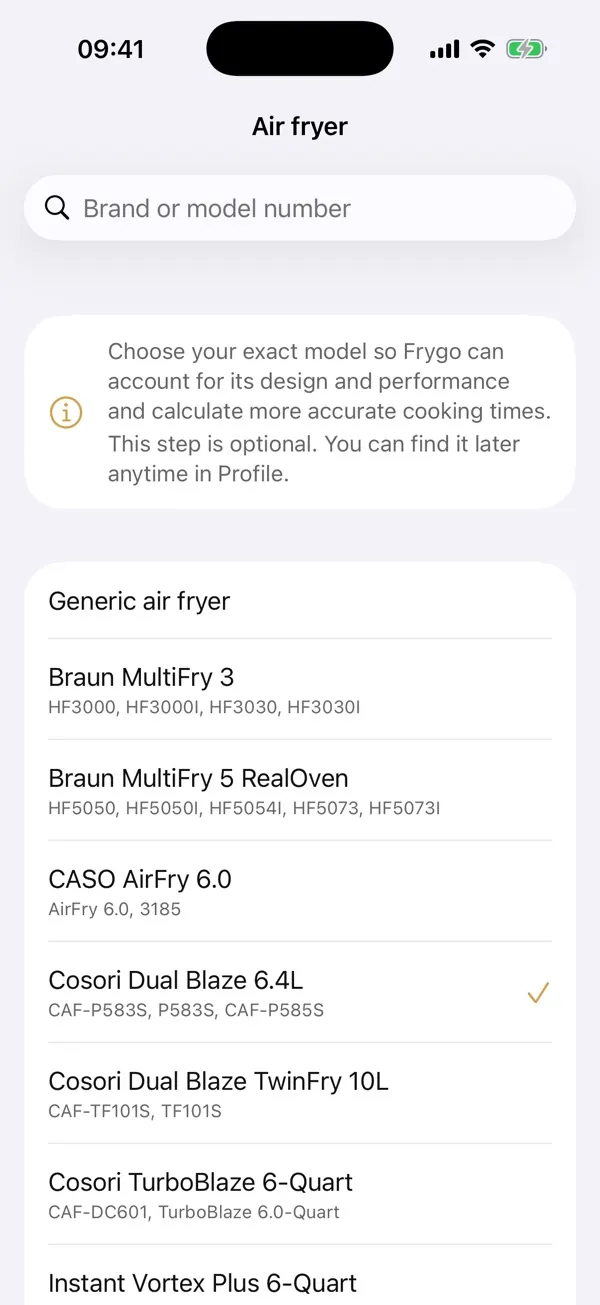
Frygo lets you select an exact supported model or the closest appliance type. It combines that profile with the food, preparation, quantity, frozen state and preferred crispiness. After cooking, your “too short, right or too long” feedback can refine future recommendations locally on your device.
Your appliance, quantity and preferred crispiness all affect the result. Frygo combines these inputs and guides you through the cook.
These ranges are general guidance, not tested results for every portion and appliance. Use the package and manufacturer instructions for your product and check doneness. Frygo adjusts in-app recommendations to your selections and feedback.
How Frygo creates recommendations →